Which vaccines do you need to travel with your family?
The simple evocation of a safari in Africa, tropical landscapes or the Mayan treasures of South America gives you the desire to take off immediately? Before flying to these exotic paradises, you often need some vaccines. Because travel is also synonymous with health, especially with children. To offer your family a relaxing holiday, Little Guest takes a look at the situation with you: which vaccines for whom and for which destination?
It is no secret that a trip abroad is something to be planned, especially if you take your happy tribe to distant lands! On the health and prevention side, vaccination is much more than a simple detail, since it can prevent you from many serious diseases.
Our Advice
Do you need to have a medical check-up before getting vaccinated?
First of all, plan a consultation with your general practitioner, or even better, in an international vaccination centre or an institute of Tropical Medicine. During this consultation, you will receive a vaccination schedule (or reminders) and essential personalized advice. Both will depend on the health situation of the country you plan to visit, the length of your stay, the condition and age of the travellers, and the type of holiday you have planned. Even if the risks are not equivalent, depending on whether you plan to stay in the protective cocoon of a 5-star hotel, or go on an adventure in the heart of the Indonesian countryside, make sure you have all the necessary information before you fly.
- To ensure a peaceful trip, remember to plan your consultation at least 6 weeks before your departure! Indeed, vaccines have an « incubation time » that requires us to take the lead! The rabies vaccine, for example, must be given at least two months before departure. Similarly, the Japanese encephalitis vaccine is given in 2 injections at 28-day intervals.
- Please note that some vaccines can only be given in approved travel medicine centres. This is particularly the case of yellow fever. Once again, an-ti-ci-pa-te!
- Do not leave without your international vaccination certificate which summarizes all the vaccines administered. This is essential, it may be required to enter certain countries, as well as your identity papers. All the more reason to pack it in your luggage!

As the official website of the Belgian public services reminds us, « vaccines are the safest protection against certain diseases specific to tropical regions« . In just over a hundred years, they have become an essential and unavoidable protection against many diseases.
With the science’s development and the appearance of many vaccines, things are more complex today than in the days of Louis Pasteur: sometimes we talk about mandatory vaccines, recommended vaccines, universal or specific vaccines… You can get a little lost! In this regard, a brief reminder of the terminology should not be too much to understand the different families of vaccines and their usefulness.
Should universal or specific vaccines be used?
For Europeans, universal vaccines are simply the « basic vaccines » that everyone can find on their health record. The ones, for example, that your little one needs to have in order to enter crèche or school. In general, parents know them inside out since they are part of the vaccination schedule for babies from the age of 2 months:
- Diphtheria, Tetanus, Polio (DTP)
- Hepatitis B
- Tuberculosis (BCG)
- Measles, Mumps, Rubella (MMR)
- Pertussis
- Cerebrospinal Meningitis and Haemophilia B (for infants)
You can learn more about universal vaccines in the United Kingdom, here.
As far as universal vaccines in the United States are concerned, this website provides valuable advice.
These universal vaccinations are quite sufficient when you plan a trip to countries with no particular health risk. For a weekend in Ireland, a week in the sun of Apulia or a road trip in France: They’re enough!
On the other hand, if your trip takes you to certain regions of the world (especially tropical regions such as Africa, Asia, Oceania or South America) you and your family will need specific vaccines. They are essential to protect you against tropical diseases.
The main so-called specific vaccines are:
- Yellow fever
- Japanese encephalitis
- Tick-borne encephalitis
- Typhoid fever
- Hepatitis A and B
- Invasive meningococcal infections
- Rabies…
Obviously your specific vaccination schedule varies according to the destination chosen and your health! Only a medical professional can determine the most appropriate vaccine protection.

What are mandatory and recommended vaccines?
A second category distinguishes between mandatory and recommended vaccines. In France, children born from 2018 onwards are subject to 11 mandatory vaccinations, without them, they cannot live in a community or go to school. In Belgium, only the polio vaccine is legally mandatory in 2019. Without a shadow of a doubt, people with parental authority must ensure that this obligation is respected, under penalty of criminal prosecution.
As the name suggests, the recommended vaccines are simply recommended by health authorities. These include influenza or chickenpox. In this case, it is a simple advice and the vaccination is based on the parents’ choice. Needless to say, these recommended vaccinations are not to be taken lightly!
Notice to long-distance travellers! The yellow fever vaccine is the only one currently required under the International Health Regulations. It is mandatory for entry into many African countries (Benin, Burkina Faso, Cameroon, Mali…) and French Guiana. Without a vaccination certificate against this terrible disease, your entry into the country will be simply refused!
And that’s not all, some countries, such as South Africa and Madagascar, require a yellow fever vaccination certificate from any traveller from countries where there is a risk of transmission of the disease (endemic inter-tropical zone of Africa or South America). This also applies to globe-trotters who have transited through an airport in a high-risk country. So also take into account your possible connection countries!
For more information on mandatory vaccinations in the UK, click here.
And for the mandatory vaccinations in the United States, here.
You should also know that the Institute of Tropical Medicine in Antwerp provides valuable advice, as well as real-time information on the risks of epidemics in exotic countries.
Which vaccines for which destinations?
Abroad, mandatory and recommended vaccines vary according to the country of destination and, as mentioned above, travel conditions. Based on the recommendations of the Pasteur Institute and WHO, Little Guest takes you on a world tour of vaccinations, from the Caribbean to French Polynesia, Asia and Africa.
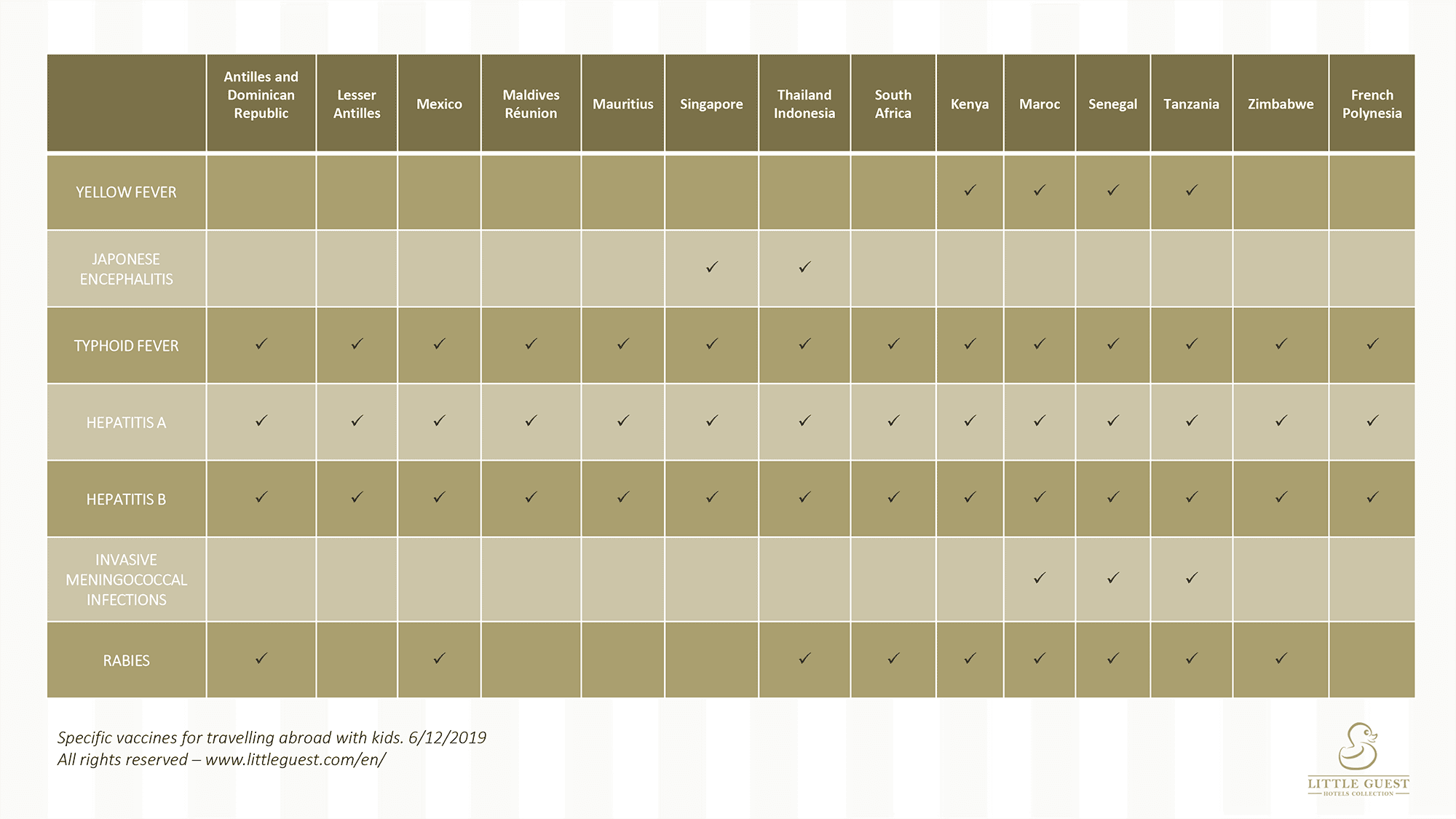
The following information and recommendations are complementary to those provided by your attending physician and should under no circumstances replace those provided during consultation.
Carribean
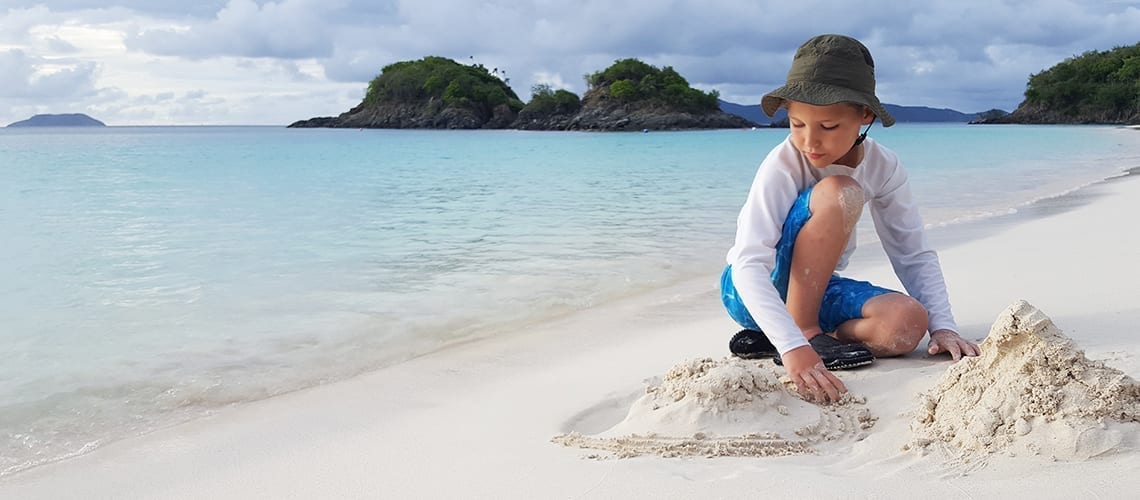
Antilles/Dominican Republic
To be done systematically before any departure to the Antilles and the Dominican Republic:
Update of the vaccines in the vaccination schedule (BCG, tetanus, polio, diphtheria, pertussis and measles…). Your doctor will be in the best position to inform you about the reminders to be made.
- Hepatitis A
- From the age of 1 year.
Depending on the terms of the stay:
- Hepatitis B
- In case of long or repeated stays.
- Rabies
- In the event of a prolonged stay in isolation. As soon as the child walks.
- Typhoid
- In case of prolonged stay or in precarious hygienic conditions. From the age of 2 years.
More information: Antigua and Barbuda, Dominican Republic
And here are all our tips to enjoy your holidays in the Dominican Republic
VIRGIN ISLANDS
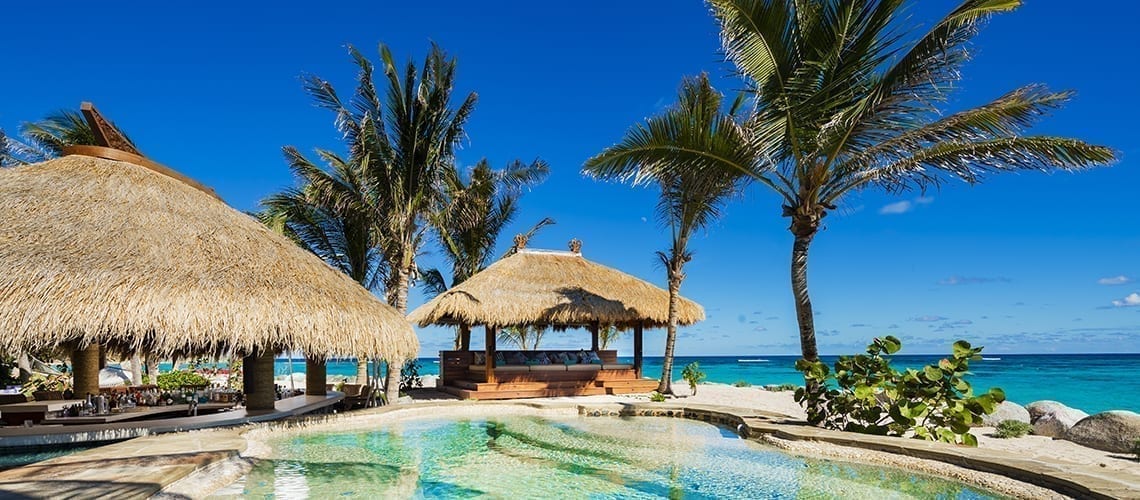
To be done systematically before any departure to the Virgin Islands:
Update of the vaccines in the vaccination schedule (BCG, tetanus, polio, diphtheria, pertussis and measles…). Your doctor will be in the best position to inform you about the reminders to be made.
- Hepatitis A
- From the age of 1 year.
Depending on the terms of the stay:
- Hepatitis B
- In case of long or repeated stays.
- Typhoid
- In case of prolonged stay or in precarious hygienic conditions. From the age of 2 years.
More information on vaccine updates in the Virgin Islands here
Saint-Barthelemy/Saint-Vincent the Grenadines
To be done systematically before any departure to St Barthelemy and St Vincent / the Grenadines
Update of the vaccines in the vaccination schedule (BCG, tetanus, polio, diphtheria, pertussis and measles…). Your doctor will be in the best position to inform you about the reminders to be made.
- Hepatitis A
- From the age of 1 year.
Depending on the terms of the stay:
- Hepatitis B
- In case of long or repeated stays.
- Typhoid
- In case of prolonged stay or in precarious hygienic conditions. From the age of 2 years.
A yellow fever vaccine certificate is required for travellers over one year of age from countries where there is a risk of yellow fever transmission and for travellers who have been in transit for more than 12 hours at an airport in a country where there is a risk of yellow fever transmission.
For St Barthelemy, you can refer to this page, and for St Vincent and the Grenadines, do not hesitate to consult these tips
Guadeloupe
To be done systematically before any departure to Guadeloupe
Update of the vaccines in the vaccination schedule (BCG, tetanus, polio, diphtheria, pertussis and measles…). Your doctor will be in the best position to inform you about the reminders to be made.
- Hepatitis A
- From the age of 1 year.
Depending on the terms of the stay and/or some travellers:
- Hepatitis B
- In case of long or repeated stays.
- Flu
- Higher risk in summer (April to October). Your current vaccine may not provide optimal coverage in the tropics. Check with your doctor.
- Pneumococcus
- In case of poor hygiene. Recommended for young children, people over 65 and people with some health problems.
A yellow fever vaccine certificate is required for travellers over one year of age from countries where there is a risk of yellow fever transmission and for travellers who have been in transit for more than 12 hours at an airport in a country where there is a risk of yellow fever transmission.
Guadeloupe presents a risk of dengue, chikungunya and zika. Don’t forget your mosquito repellent!
More info on vaccine updates in Guadeloupe here and there.
Central America
Mexico
To be done systematically before any departure to Mexico:
Update of the vaccines in the vaccination schedule (BCG, tetanus, polio, diphtheria, pertussis and measles…). Your doctor will be in the best position to inform you about the reminders to be made.
- Hepatitis A
- From the age of 1 year.
Depending on the terms of the stay:
- Hepatitis B
-
- In case of long or repeated stays.
-
- Rabies
-
- In the event of a prolonged stay in isolation. As soon as the child walks.
-
- Typhoid
- In case of prolonged stay or in precarious hygienic conditions. From the age of 2 years.
Learn more about immunization for travel to Mexico, here.
All our holiday advice and quality accommodation in the Yucatan peninsula are included in this beautiful guide
Indian Ocean
The Maldives/Réunion Island
To be done systematically before any departure to the Maldives or Reunion Island:
Update of the vaccines in the vaccination schedule (BCG, tetanus, polio, diphtheria, pertussis and measles…). Your doctor will be in the best position to inform you about the reminders to be made.
- Hepatitis A
- From the age of 1 year.
Depending on the terms of the stay:
- Hepatitis B
- In case of long or repeated stays.
- Typhoid
- In case of prolonged stay or in precarious hygienic conditions.
From the age of 2 years.
- In case of prolonged stay or in precarious hygienic conditions.
A certificate of yellow fever vaccine is required at the entry of the country, for travellers over 9 months of age from countries where there is a risk of yellow fever transmission and travellers who have transited through an airport in a country where there is a risk of yellow fever transmission. Consult the list, here.
Learn more about the Maldives, in this page
For vaccines in Reunion Island, do not hesitate to refer to this information.
And to make sure you don’t forget anything before you leave and make your stay on this extraordinary island even more memorable, don’t miss this article
MAURITIUS ISLAND

To be done systematically before any departure to Mauritius Island:
Update of the vaccines in the vaccination schedule (BCG, tetanus, polio, diphtheria, pertussis and measles…). Your doctor will be in the best position to inform you about the reminders to be made.
- Hepatitis A
-
- From the age of 1 year.
-
Depending on the terms of the stay:
- Hepatitis B
- In case of long or repeated stays.
- Typhoid
- In case of prolonged stay or in precarious hygienic conditions.
From the age of 2 years.
- In case of prolonged stay or in precarious hygienic conditions.
Learn everything about vaccines before leaving for Mauritius, here.
Our practical guide will certainly be useful for you as well.
Asia

Singapore
To be done systematically before any departure to Singapore:
Update of the vaccines in the vaccination schedule (BCG, tetanus, polio, diphtheria, pertussis and measles…). Your doctor will be in the best position to inform you about the reminders to be made.
- Hepatitis A
- From the age of 1 year.
Depending on the terms of the stay:
- Japanese encephalitis
- For expatriates or people who need to stay in rural areas during the transmission period. From the age of 2 months.
- Hepatitis B
- In case of long or repeated stays.
Typhoid: in case of prolonged stay or in precarious hygienic conditions. From the age of 2 years.
A certificate of yellow fever vaccine is required at the entry of the country, for travellers over 9 months of age from countries where there is a risk of yellow fever transmission.
To travel safely to Singapore, refer to this source
A nice travel guide is also available here
Thailand/Indonesia
To be done systematically before any departure to Thailand or Indonesia:
Update of the vaccines in the vaccination schedule (BCG, tetanus, polio, diphtheria, pertussis and measles…). Your doctor will be in the best position to inform you about the reminders to be made.
- Hepatitis A
- From the age of 1 year.
Depending on the terms of the stay:
- Japanese encephalitis
- For expatriates or people who need to stay in rural areas during the transmission period. From the age of 2 months.
- Hepatitis B
- In case of long or repeated stays.
- Rabies
- In the event of a prolonged stay in isolation. As soon as the child walks.
- Typhoid
- In case of prolonged stay or in precarious hygienic conditions. From the age of 2 years.
A certificate of yellow fever vaccine is required at the entrance to the country for travellers over 9 months of age from countries where there is a risk of yellow fever transmission.
You will find more medical information about Thailand here, and for Indonesia, here are the appropriate tips.
Our guide to Thailand is very useful if you are looking for the best destinations for accommodation and activities.
If you are interested in Bali, « the island of Gods », consult this guide, it is full of tips & tricks!
Africa

South Africa
To be done systematically before any departure to South Africa:
Update of the vaccines in the vaccination schedule (BCG, tetanus, polio, diphtheria, pertussis and measles…). Your doctor will be in the best position to inform you about the reminders to be made.
- Hepatitis A
- From the age of 1 year.
Depending on the terms of the stay:
- Hepatitis B:
- In case of long or repeated stays. From the age of 2 months.
- Rabies
- In the event of a prolonged stay in isolation. As soon as the child walks.
- Typhoid
- In case of prolonged stay or in precarious hygienic conditions. From the age of 2 years.
A yellow fever vaccine certificate is required for travellers over one year of age from countries where there is a risk of yellow fever transmission and for travellers who have been in transit for more than 12 hours at an airport in a country where there is a risk of yellow fever transmission.
For a safe safari, please refer to this information
To discover the vastness of South Africa and enjoy an unforgettable stay with your family, here are all our tips
Kenya
To be done systematically before any departure to Kenya:
Update of the vaccines in the vaccination schedule (BCG, tetanus, polio, diphtheria, pertussis and measles…). Your doctor will be in the best position to inform you about the reminders to be made.
- Hepatitis A
- From the age of 1 year.
Depending on the terms of the stay:
- Yellow fever
- Vaccination is recommended for travellers, unless their itinerary is limited to the following areas: the entire north-eastern province, the states of Kilifi, Kwale, Lamu, Malindi and Tana river in coastal province, and the cities of Nairobi and Mombasa; in these areas, however, vaccination may be considered if there is a risk of mosquito bite exposure. From the age of 9 months.
A yellow fever vaccine certificate is required for travellers over one year of age from countries where there is a risk of yellow fever transmission.
- Hepatitis B
- In case of long or repeated stays.
- Rabies
- In the event of a prolonged stay in isolation. As soon as the child walks.
- Typhoid:
- In case of prolonged stay or in precarious hygienic conditions. From the age of 2 years.
Here are all the advice for this magnificent African destination
Morocco
To be done systematically before any departure to Morocco:
Update of the vaccines in the vaccination schedule (BCG, tetanus, polio, diphtheria, pertussis and measles…). Your doctor will be in the best position to inform you about the reminders to be made.
- Hepatitis A
- From the age of 1 year.
Depending on the terms of the stay:
- Hepatitis B
- In case of long or repeated stays.
- Rabies
- In the event of a prolonged stay in isolation. As soon as the child walks.
- Typhoid
- In case of prolonged stay or in precarious hygienic conditions. From the age of 2 years.
If you want to fly to Morocco in complete peace of mind, visit this page
Little Guest has also prepared a very nice home travel guide for you
Senegal
To be done systematically before any departure to Senegal:
Update of the vaccines in the vaccination schedule (BCG, tetanus, polio, diphtheria, pertussis and measles…). Your doctor will be in the best position to inform you about the reminders to be made.
- Hepatitis A
- From the age of 1 year.
- Yellow fever
- From the age of 9 months (between 6 and 9 months, only in special circumstances).
A certificate of yellow fever vaccine is required at the entry of the country, for travellers over 9 months of age from countries where there is a risk of yellow fever transmission and travellers who have transited through an airport in a country where there is a risk of yellow fever transmission.
Depending on the terms of the stay:
- Hepatitis B
- In case of long or repeated stays.
- Meningococcal meningitis
- In the event of a prolonged stay in close contact with the local population, or in times of epidemic.
- Rabies
- In the event of a prolonged stay in isolation. As soon as the child walks.
- Typhoid
- In case of prolonged stay or in precarious hygienic conditions. From the age of 2 years.
Senegal in full health and without worry, here
Tanzania
To be done systematically before any departure to Tanzania:
Update of the vaccines in the vaccination schedule (BCG, tetanus, polio, diphtheria, pertussis and measles…). Your doctor will be in the best position to inform you about the reminders to be made.
- Hepatitis A
- From the age of 1 year.
- Yellow fever
- This vaccination is generally not recommended for travellers to Tanzania; however, it may be considered in the event of significant exposure to mosquito bites. From the age of 9 months (between 6 and 9 months, only in special circumstances).
A certificate of yellow fever vaccine is required for travellers over one year of age from countries where there is a risk of yellow fever transmission and for travellers who have been in transit for more than 12 hours at an airport in a country where there is a risk of yellow fever transmission.
Depending on the terms of the stay:
- Hepatitis B
- In case of long or repeated stays.
- Meningococcal meningitis
- In the event of a prolonged stay in close contact with the local population, or in times of epidemic.
- Rabies
- In the event of a prolonged stay in isolation. As soon as the child walks.
- Typhoid
- In case of prolonged stay or in precarious hygienic conditions. From the age of 2 years.
To enjoy Tanzania in complete peace of mind, do not hesitate to visit this page
Zimbabwe
To be done systematically before any departure to Zimbabwe:
Update of the vaccines in the vaccination schedule (BCG, tetanus, polio, diphtheria, pertussis and measles…). Your doctor will be in the best position to inform you about the reminders to be made.
- Hepatitis A
- From the age of 1 year.
Depending on the terms of the stay:
- Hepatitis B
- In case of long or repeated stays.
- Rabies
- In the event of a prolonged stay in isolation. As soon as the child walks.
- Typhoid
- In case of prolonged stay or in precarious hygienic conditions. From the age of 2 years.
Yellow fever:
A certificate of yellow fever vaccine is required for travellers over one year of age from countries where there is a risk of yellow fever transmission and for travellers who have been in transit for more than 12 hours at an airport in a country where there is a risk of yellow fever transmission.
Learn more, here
Pacific Ocean
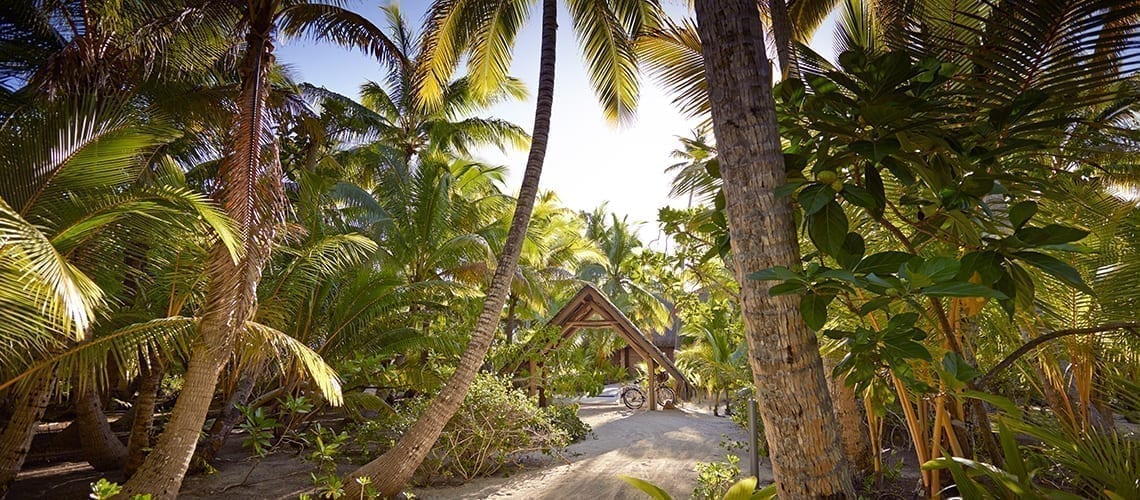
French Polynesia
To be done systematically before any departure to French Polynesia:
Update of the vaccines in the vaccination schedule (BCG, tetanus, polio, diphtheria, pertussis and measles…). Your doctor will be in the best position to inform you about the reminders to be made.
- Hepatitis A
- From the age of 1 year.
Depending on the terms of the stay:
- Hepatitis B: In case of long or repeated stays.
- Typhoid: in case of prolonged stay or in precarious hygienic conditions. From the age of 2 years.
All the tips before flying to French Polynesia can be found here

Now you are ready to travel safely with your children!

Mylène, 28 years old, art and travel lover, from Strasbourg, France
SOURCES
Our best-sellers hotels
You will also like


